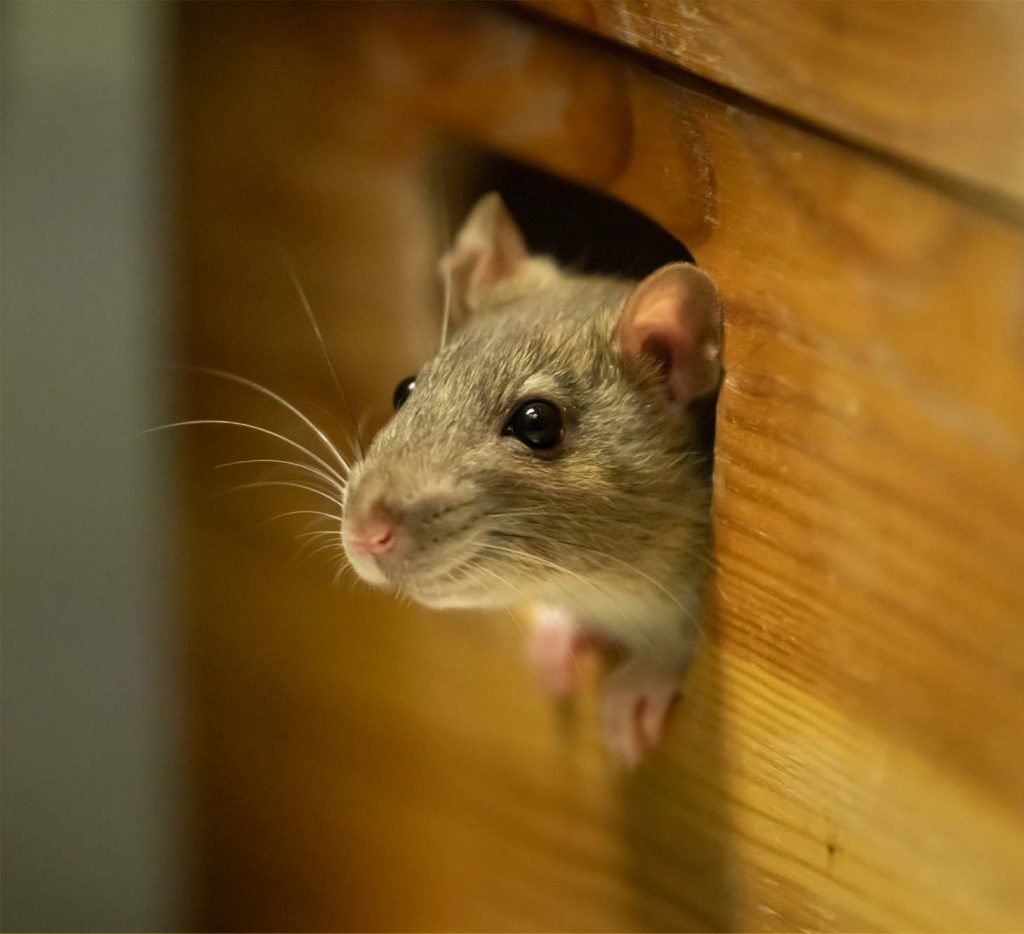


House Mice
House mice are dusty gray to light brown with a cream or light gray belly. They’re body length is 2½–3¾ inches (6–10 cm) and tail length 2¾–4 inches (7–10 cm), nearly as long as the body. House mice have a pointed muzzle and small, black eyes. Their ears are large compared to the head with very little hair.
Behavior
Females breed rapidly and can produce 5–10 litters per year, with 4–12 pups per litter. Under ideal conditions, a single female can produce 30–70 offspring in one year. Baby mice are called pups and are born blind, hairless, and completely dependent on their mother. Pups reach sexual maturity in as little as 5–8 weeks, allowing populations to grow very quickly.
House mice are mostly nocturnal, but daytime activity often indicates a large population or food competition. They are excellent climbers, jumpers, swimmers, and can squeeze through openings as small as ¼ inch (about the diameter of a pencil). They usually travel only 10–30 feet from their nest if food and water are readily available. These rodents create established travel routes along walls because they prefer staying in protected areas.
House mice prefer cereal grains and seeds but will eat almost any available food, including pet food, insects, chocolate, and grease. They build nests from shredded paper, insulation, fabric, cotton, dryer lint, and other soft materials. They also constantly gnaw because their incisors grow throughout their lives.
Signs of an Infestation
- Droppings: ⅛–¼ inch long, rod-shaped with pointed ends.
- Gnaw Marks: Fresh gnaw marks are light-colored and become darker over time.
- Tracks: Four toes on the front feet and five toes on the hind feet.
- Rub Marks: Oily streaks left along walls and baseboards.
- Runways: Repeated travel paths marked by droppings, rub marks, and footprints.
- Nests: Shredded paper, insulation, fabric, or other soft materials hidden inside walls, cabinets, attics, or storage areas.
- Scratching Noises: Often heard in walls, ceilings, or attics, especially at night.
- Strong Musky Odor: Heavy infestations often produce a noticeable ammonia-like smell from urine.
- Chewed Food Packaging: Holes in cereal boxes, pet food bags, and pantry items.
- Actual Mouse Sightings: Seeing a mouse during the day often suggests a larger infestation.

Norway Rat
Norway rats have brown or grayish-brown fur with scattered black hairs; underside is usually gray, white, or yellowish. They’re 7–10 inches long (body); can reach 16 inches or more including the tail. They typically weigh 7–18 ounces and have a blunt muzzle (unlike the pointed muzzle of the house mouse), small eyes, and small ears covered with hair. Their tail is shorter than the combined length of the head and body and are a heavy, thick-bodied rodent with a stocky appearance.
Habits
Norway rats are primarily nocturnal, becoming most active at dusk and before dawn. They are social animals and often live in colonies. Where you find one burrow, there are often additional burrows nearby. These rats typically live close to food and water sources.
Norway rats commonly enter buildings in the fall and winter when outdoor food sources become limited. They usually create nests from shredded paper, fabric, insulation, and other soft materials. They are excellent swimmers and may enter homes through damaged sewer lines or plumbing openings.
Fun Facts:
- They’re also known as the brown rat, sewer rat, or wharf rat.
- One of the most common rats found in urban environments.
- Excellent senses of smell, hearing, touch, and taste, which help them navigate in dark environments.
- Have poor eyesight and limited color vision.
- Their front teeth continuously grow throughout their lives, requiring them to constantly gnaw.
- Can chew through materials such as wood, plastic, insulation, and even some softer metals.
- Excellent swimmers and can tread water for several days.
- Can hold their breath underwater for several minutes.
- Can jump approximately 2–3 feet vertically.
- Can squeeze through openings as small as ½ inch.
- A rat’s teeth never stop growing, so they must constantly chew to keep them worn down.
- Despite their reputation, rats are highly intelligent and can learn complex routes and solve problems.
- Rats use their whiskers to help navigate tight spaces and detect changes in their surroundings.
- Norway rats are mostly ground dwellers, while roof rats are more likely to climb and live in elevated areas.
- Rats can remember pathways and return to reliable food sources repeatedly.
- Their whiskers are nearly as sensitive as human fingertips.
- A rat can fall several feet without serious injury due to its flexible body.

Deer Mice
Deer mice are usually brown, grayish-brown, or reddish-brown on the back with a white belly and white feet and approximately 5–8 inches long including the tail. They body is about 2½–4 inches in length. They’re tail is long and distinctly bicolored, typically dark on top and white underneath. They’re ears are large compared to the size of the head and eyes are also large and beady to help with nighttime activity.
Deer mice are often mistaken for a house mouse, but deer mice typically have larger eyes, larger ears, and a sharply contrasting white underside. They are primarily outdoor rodents but may enter structures when searching for food, shelter, or warmth.
These rodents are nocturnal and most active at night. They are excellent climbers and jumpers and usually stay within a small area near their nest but may travel farther when searching for food.
Fun Facts:
- Deer mice are named for their white belly and feet, which resemble the coloring of a deer.
- They can jump several feet despite their tiny size.
- Deer mice have excellent memory and can remember locations of food caches.
- Their tails help them balance while climbing and jumping.
- They are great climbers and can access areas many homeowners assume are unreachable.
- Deer mice can survive in very cold environments by nesting in protected areas and reducing activity.
- A deer mouse can fit through a hole about the size of a pencil eraser (¼ inch).